

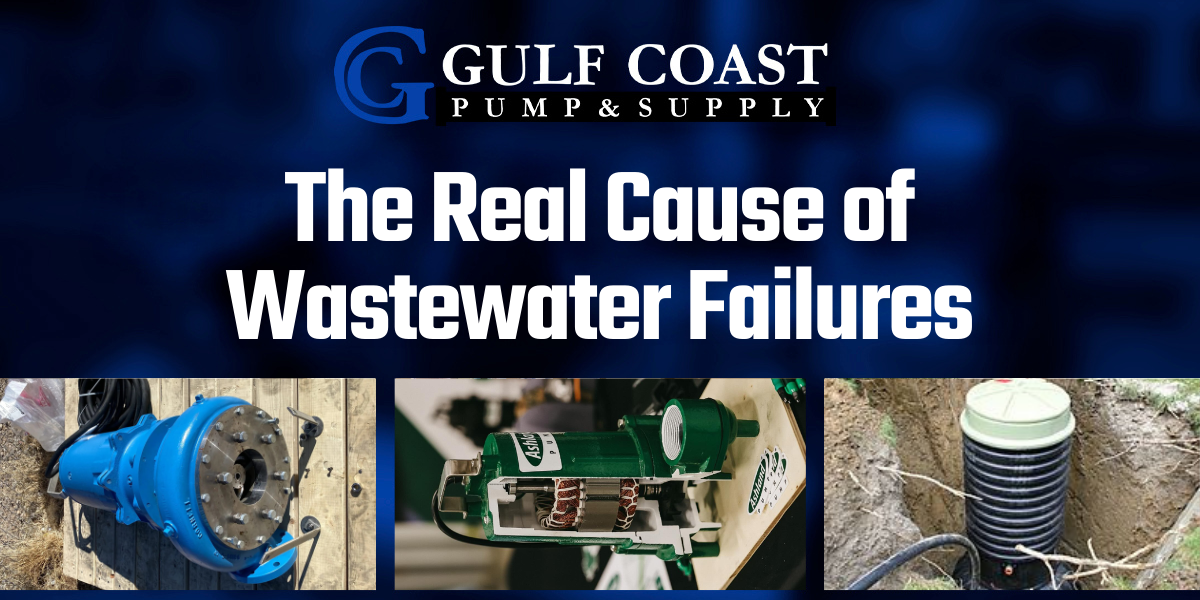
Municipal wastewater systems don’t fail because of how much they handle.
They fail because of what’s moving through them.
Wipes, grease, and debris enter the system every day. Without proper processing, that material builds up fast—leading to clogged pumps, increased maintenance, lift station overflows, and compliance risks.
If systems are constantly reacting instead of running efficiently, the issue is rarely capacity. It’s how waste is being handled before it moves downstream.
That’s where grinder pumps come in.
What Is a Grinder Pump?
A grinder pump is a submersible wastewater pump designed to break down solid waste into a fine slurry before pumping.
Instead of forcing debris through the system intact, grinder pumps use a cutting mechanism to reduce materials like wipes, paper products, and organic waste. Once processed, the slurry moves efficiently through pressurized systems.
This makes it possible to transport wastewater through force mains, smaller diameter piping, and flat terrain without constant blockages.
Why Waste Processing Matters
Wastewater isn’t consistent. Residential discharge, commercial waste, and storm-related inflow all introduce variability.
That variability leads to:
- Ragging from wipes and fibrous materials
- Debris buildup in lift stations
- Pump clogging
- Reduced system efficiency
Without proper processing at the front end, these issues compound—causing downtime, higher operating costs, and system instability.
Grinder pumps solve this by addressing the problem before it spreads through the system.
Where Grinder Pumps Work Best
Grinder pumps are commonly used in:
- Municipal and residential lift stations
- Low-pressure sewer systems
- Areas without reliable gravity flow
- Long-distance or pressurized wastewater transport
They are especially effective in expanding municipalities where traditional infrastructure isn’t practical.
Design Still Determines Performance
Grinder pumps are built for lower flow, higher head applications. They are not designed for high-volume stormwater movement.
To perform correctly, systems must account for:
- Total Dynamic Head (TDH)
- Peak flow demand
- Waste composition
- Force main sizing and pressure
Ignoring these factors leads to underperformance, excessive wear, and premature failure.
Grinder pumps also include wear components—like cutting assemblies—that require routine maintenance to stay effective.
The System Matters More Than the Pump
In municipal wastewater, equipment alone doesn’t solve the problem. System design does.
Grinder pumps are highly effective—but only when used in the right conditions. Misapplication leads to the same failures operators are trying to prevent.
Understanding flow conditions, debris load, and infrastructure limitations is what separates a reliable system from one that constantly breaks down.
At Gulf Coast Pump & Supply, we work directly with contractors, municipalities, and engineers to identify what’s actually causing the issue—and what needs to change.
You get straight answers based on real-world application, not guesswork.
Call 713-903-3215 and fix the problem at the source.