


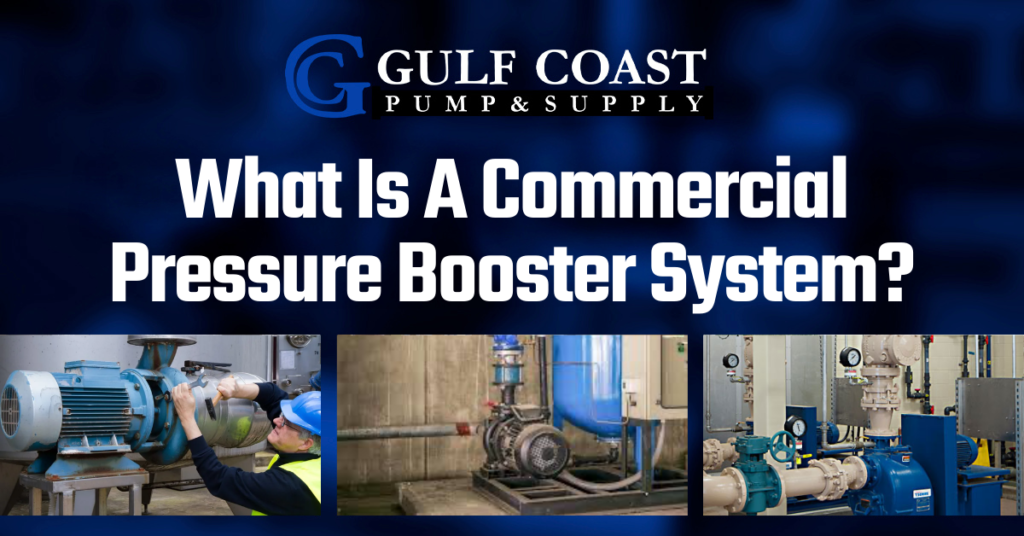
A commercial pressure booster system is basically the muscle behind your building’s water delivery. It’s an engineered assembly that increases water pressure so fluids can reach every floor, every fixture, and every piece of equipment that needs it—no matter how tall the building or how far the water has to travel.
Unlike the small residential units you might see in a house, commercial boosters are built for serious volume and serious lift. We’re talking about high-rise office buildings, hospitals, industrial facilities—places where water pressure isn’t just a convenience, it’s mission-critical.
When pressure drops in a commercial setting, the consequences are real. HVAC cooling towers stop working. Fire suppression systems can’t do their job. Lab equipment malfunctions. And all of that leads to downtime, which means lost money and potential safety issues.
Why Commercial Buildings Lose Pressure
Commercial buildings face pressure challenges that residential properties just don’t deal with. Here’s what’s working against you:
Gravity Is Your Enemy (Hydrostatic Pressure Loss)
In a multi-story building, gravity is constantly fighting your water supply. For every foot of elevation, you lose about 0.433 psi. So if your municipal water comes in at decent pressure on the ground floor, by the time it climbs ten stories, it’s barely a trickle—if it makes it at all.
The weight of that water column is literally pushing back against the flow. Without a booster system, the upper floors are going to struggle.
Long Pipe Runs Mean Friction Loss
Commercial buildings have miles of internal piping. As water travels through all that copper or steel, friction against the pipe walls eats away at your pressure. Every elbow, tee, and valve adds resistance.
The farther your high-demand zones are from the main service entrance, the worse this gets. It’s just physics—water doesn’t want to travel long distances at high speed without losing energy.
Municipal Supply Isn’t Always Consistent
The water coming from the city of Houston’s main, for example, is designed to serve the general grid at a baseline pressure. But during peak hours—like morning rush in a business district—that pressure can drop significantly.
If you’re in a high-occupancy building during one of those dips, you’re not getting what you need for sanitary systems, mechanical equipment, or even basic fixtures.
High-Demand Equipment Needs More
Commercial buildings house equipment that demands specific pressure thresholds. Industrial dishwashers, large-scale laundry facilities, water filtration systems, reverse osmosis units—all of these create a heavy “draw” on the system.
If you don’t have a dedicated booster managing that demand, these systems can starve other fixtures of pressure. It’s a balancing act that requires professional-grade equipment.
Age and Obstructions Don’t Help
Scale buildup in older pipes or debris caught in strainers can make it seem like you’ve got a pressure problem when really you’ve got a maintenance problem. A pump can’t fix clogged pipes.
That said, even in modern builds, backflow preventers and other safety devices create resistance that high-efficiency boosters are designed to overcome.
How Commercial Boosters Actually Work
Most commercial pressure boosters use centrifugal force—high-speed impellers that accelerate the fluid and push it where it needs to go. The smart ones use Variable Frequency Drive (VFD) controllers, which let the pump speed up or slow down based on real-time demand.
This is huge for energy costs and equipment life. The pump only works as hard as it needs to.
The Key Components
High-Efficiency Motors: These are typically TEFC (Totally Enclosed Fan Cooled) motors built for continuous duty in mechanical rooms. They don’t quit.
Multi-Stage Impellers: For skyscrapers and buildings with serious vertical lift requirements, you stack impellers to create higher “head” capacity.
VFD Controllers: The digital brain that keeps pressure constant no matter how demand fluctuates. This is what makes modern systems so efficient.
Transducers and Sensors: Precision instruments monitoring suction and discharge pressure in real time, automating the whole operation.
Where These Systems Get Used
Commercial boosters are the backbone of fluid management in high-stakes environments:
High-Rise Office & Residential Buildings: Making sure penthouses and executive suites on the 40th floor get the same water pressure as the lobby.
Industrial Cooling Systems: Providing the flow needed for cooling jackets and heat exchangers in manufacturing plants and data centers.
Sustainable Infrastructure: Re-pressurizing treated greywater or rainwater for LEED-certified irrigation and toilet flushing.
The scale of your system depends on your building’s peak load. A small office might get by with a single pump (simplex), but a major hospital or stadium often needs a triplex or even quadraplex setup—multiple pumps running in parallel to handle massive surge demands.
The Role of Hydropneumatic Tanks
In commercial applications, you’ll often see a hydropneumatic expansion tank paired with the booster system. This tank has a pressurized air bladder that acts as a buffer for the entire building.
It stores a specific volume of pressurized water (called the drawdown), which lets the system handle low-flow demands—like a single faucet running in a janitorial closet—without firing up the big main motors every time.
This prevents “short-cycling,” which is the number one cause of premature motor failure and electrical issues in commercial installations.
Choosing the Right System
You can’t just pick a booster off a shelf and hope it works. Commercial systems require a professional hydraulic analysis. Here’s what needs to be calculated:
Total Dynamic Head (TDH)
This is the total equivalent height the water has to be lifted, accounting for all friction losses in the system. Get this wrong and your pump either won’t perform or will over-pressurize and damage pipes.
Peak Demand (GPM)
You need to know the maximum simultaneous water usage your building will see. This is usually calculated using Hunter’s Curve or similar engineering standards based on occupancy and fixture count.
Net Positive Suction Head (NPSH)
This ensures the incoming municipal supply is sufficient to keep the pump from cavitating, which can destroy equipment fast.
Redundancy Requirements
Does your facility need “N+1” redundancy? That means even if one pump goes offline for maintenance, the building stays fully operational. For hospitals and critical facilities, this isn’t optional.
Work With People Who Know What They’re Doing
Selecting the wrong booster system can lead to catastrophic pipe damage from over-pressurization—or worse, system failure during peak business hours when you need it most.
At Gulf Coast, we specialize in high-capacity fluid dynamics for commercial and contracting projects. We handle the load calculations, VFD programming, and skid integration to make sure your building’s water infrastructure is both robust and energy-efficient.
You shouldn’t be guessing on something this critical. Let’s get it right the first time. Give us a call: 713-903-3215.