


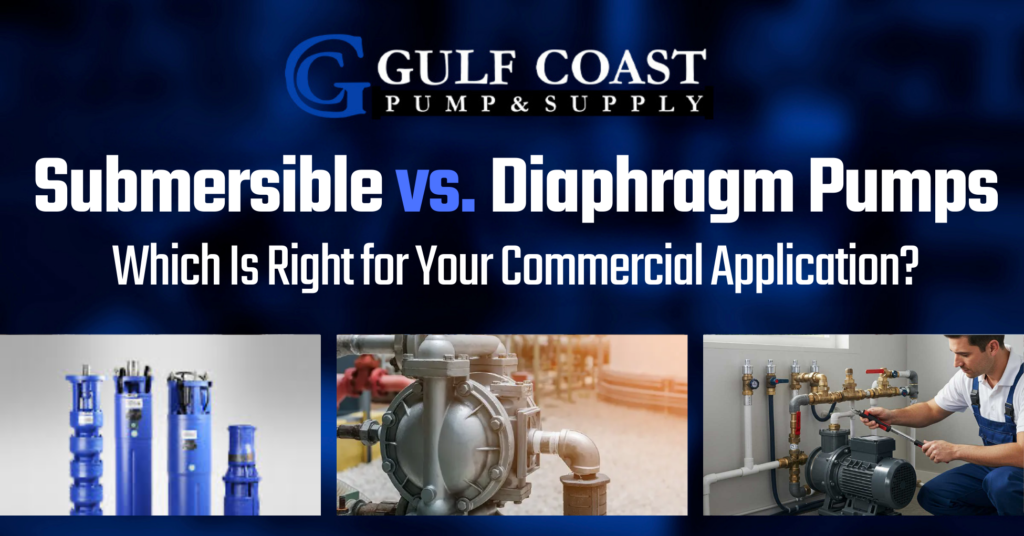
Choosing between a submersible pump and a diaphragm pump isn’t a product decision. It’s an engineering decision.
Both are built for commercial and industrial environments. Both move fluids reliably when properly specified. But they operate on completely different mechanical principles—and selecting the wrong one can lead to premature failure, inefficient performance, and costly downtime.
In Houston’s commercial landscape—wastewater systems, construction sites, oil & gas facilities, groundwater control, and flood mitigation—the difference matters.
When a pump underperforms in a commercial setting, the consequences are real. Lift stations back up. Dewatering projects stall. Processing equipment shuts down. Flood control systems lose capacity. And downtime in commercial operations isn’t measured in inconvenience—it’s measured in lost revenue and compliance risk.
Understanding how these two pump types work is the first step toward choosing correctly.
What Is a Submersible Water Pump?
A submersible water pump is designed to operate fully submerged in the fluid it’s moving. The motor is sealed in a watertight housing and directly coupled to the pump assembly.
Unlike surface-mounted pumps that pull fluid upward, submersible pumps push fluid to the surface.
That distinction eliminates many suction limitations.
Because the pump sits below the fluid level:
- Priming issues are eliminated
- Suction lift limitations are reduced
- Cavitation risk decreases (when properly engineered)
Submersible pumps are commonly used in:
- Wastewater lift stations
- Stormwater systems
- Groundwater management
- Construction dewatering
- Flood control basins
In Houston, where high groundwater tables and below-grade infrastructure are common, submersible pumps are often the backbone of commercial water movement systems.
What Is a Diaphragm Pump?
A diaphragm pump works on an entirely different principle.
Instead of using centrifugal force, it uses a flexible diaphragm that moves back and forth inside a chamber. As the diaphragm retracts, it creates suction that draws fluid in. As it pushes forward, it forces fluid out through a discharge valve.
This is known as a positive displacement pump.
Unlike centrifugal pumps, diaphragm pumps move a fixed volume of fluid per cycle regardless of pressure (within design limits). That mechanical difference changes everything.
Diaphragm pumps are commonly used in:
- Sludge transfer
- Chemical handling
- Oil & gas operations
- Mining and slurry applications
- Industrial washdown
- Construction sites with heavy debris
They are built for durability in environments where fluid characteristics are unpredictable.
Why Commercial Facilities Choose the Wrong Pump
Commercial applications fail when pump selection is based on assumptions instead of load calculations.
Here’s where mistakes happen.
Fluid Type Is the First Decision
Submersible pumps perform best when moving large volumes of relatively clean or lightly contaminated water.
Stormwater. Groundwater. Treated wastewater.
But when fluid contains:
- High solids content
- Thick sludge
- Abrasive slurry
- Viscous chemical mixtures
Centrifugal impellers can clog or wear prematurely.
Diaphragm pumps tolerate solids and viscosity better because they don’t rely on high-speed impeller rotation. Their displacement mechanism handles debris more effectively.
If you’re moving sludge or slurry, a diaphragm pump is often the safer engineering choice.
Flow Rate Requirements Matter
Submersible pumps are generally better suited for high continuous flow rates.
If your application demands:
- Large GPM output
- Continuous duty operation
- Flood evacuation
- Rapid basin drawdown
Submersible centrifugal systems typically provide greater efficiency.
Diaphragm pumps, while powerful, are better suited for moderate flow applications where fluid consistency matters more than volume.
Choosing a diaphragm pump for high-volume flood mitigation in Houston, for example, would likely result in underperformance.
Suction and Lift Conditions Change the Equation
Submersible pumps push fluid upward from within the basin. That eliminates long suction lines and reduces priming issues.
Diaphragm pumps are typically surface-mounted and can self-prime. They can lift fluid from below-grade areas without being submerged.
In commercial construction sites or oil & gas operations, where equipment needs to remain accessible, diaphragm systems often make more logistical sense.
Application environment should drive the decision—not convenience.
Solids Handling Is a Major Factor in Houston
Houston’s stormwater and construction runoff often contain debris, sediment, and organic material.
Submersible pumps can be engineered for solids handling, but not all models are equal. Impeller design and clearance tolerances matter.
Diaphragm pumps, by design, tolerate solids more consistently without performance degradation.
If debris loading is heavy, choosing the wrong centrifugal design will result in repeated service calls.
Energy Efficiency and Operational Cost
For moving large volumes of water continuously, submersible centrifugal pumps are typically more energy-efficient.
They rely on rotational energy transfer and perform best along properly matched pump curves.
Diaphragm pumps consume more energy per gallon moved because of their reciprocating mechanism. However, in sludge or viscous applications, they outperform centrifugal pumps that would otherwise lose efficiency.
Energy efficiency isn’t about motor size alone. It’s about matching the pump curve to the system curve.
Without calculating Total Dynamic Head (TDH), you’re operating blind.
Maintenance Considerations
Submersible pumps operate underwater or below grade. Servicing them requires removal from the basin.
Seal integrity is critical. If seals fail, water intrusion can destroy the motor quickly.
Diaphragm pumps are surface-mounted and easier to access. However, diaphragms are wear components and require periodic replacement.
Neither system is maintenance-free. Both require planning based on duty cycle and environment.
Choosing the Right System Requires Calculation
You can’t select a commercial pump based on horsepower alone.
Proper selection requires calculating:
Total Dynamic Head (TDH)
This accounts for elevation changes and friction losses in piping. An incorrect TDH calculation results in poor performance or system damage.
Required Flow Rate (GPM)
Peak load conditions must be evaluated—not just average demand.
Net Positive Suction Head (NPSH)
This ensures the pump will not cavitate under expected suction conditions.
Solids Content and Fluid Characteristics
Viscosity and debris size determine mechanical suitability.
Redundancy Requirements
Critical facilities may require duplex or triplex configurations to ensure uninterrupted operation.
Without these numbers, pump selection becomes guesswork.
And in commercial infrastructure, guesswork leads to failure.
Where These Pumps Get Used in Houston Commercial Applications
Submersible Pumps:
- Wastewater lift stations
- Stormwater detention systems
- Groundwater control
- Flood mitigation infrastructure
Diaphragm Pumps:
- Sludge and slurry transfer
- Oil & gas processing
- Mining operations
- Chemical movement
- Construction site dewatering with heavy debris
The right pump depends on the environment, not the label.
Work With People Who Understand Application Engineering
Submersible and diaphragm pumps are not interchangeable solutions.
Selecting the wrong one leads to:
- Reduced system life
- Excess energy consumption
- Seal failure
- Clogged impellers
- Motor overload
- Operational shutdown
At Gulf Coast Pump & Supply, we work exclusively with commercial, municipal, and industrial clients across Houston. We evaluate load requirements, fluid characteristics, and system conditions before recommending equipment.
We don’t sell to the public. We engineer solutions for real-world commercial demand.
If you’re evaluating a pump upgrade or experiencing performance issues, let’s look at the numbers before you commit to the wrong system.
Get it right the first time.
Call Gulf Coast Pump at 713-903-3215.