


In any large-scale commercial building, manufacturing plant, or municipal facility, utilities represent a massive chunk of overhead costs. What many facility managers oversee, however, is exactly where that electrical power is being consumed.
Studies show that electric motor-driven systems consume over half of all electricity utilized by industries. Among those systems, pumps are often the single largest energy consumer, accounting for up to 25% to 50% of the energy usage in certain industrial operations.
Here is a technical breakdown of why your pumps are wasting electricity and how a professional pump audit can protect your bottom line.
Why Is My Commercial Water Pump Consuming So Much Power?
When a facility experiences a sudden spike in electrical bills, the HVAC or lighting systems are usually blamed first. However, inefficient pumping systems often operate silently in the background, draining thousands of dollars due to hidden technical flaws.
The most common culprits behind low commercial pump efficiency include:
-
Oversized Equipment (The Safety Margin Trap): During the design phase of many commercial buildings, engineers often add excessive safety margins to the required Head (pressure) and Flow parameters. This results in choosing a pump that is significantly larger than what the system actually requires, forcing it to run choked or bypassed.
-
Throttling Valves to Control Flow: If a pump is oversized, operators frequently use discharge valves to choke the flow to the desired rate. This is the mechanical equivalent of driving a car with your foot floor-pressed on the gas pedal while simultaneously applying the brakes.
-
System Degradation over Time: Internal wear, impeller erosion, scale buildup, and failing mechanical seals force the motor to work significantly harder to move the exact same volume of fluid.
What Is Best Efficiency Point (BEP) in Pumping Systems?
Every centrifugal pump is engineered to operate most efficiently at a very specific combination of head and flow rate. This sweet spot on the manufacturer’s pump curve is known as the Best Efficiency Point (BEP).
When a pump operates at its BEP, the hydraulic efficiency is maximized, and the mechanical loads on the impeller, shaft, and bearings are minimized.
The Cost of Operating Off-Design
If your system operates too far to the left (low flow, high head) or too far to the right (high flow, low head) of the BEP, energy consumption skyrockets in proportion to the useful work being done. Operating outside the BEP doesn’t just increase your utility bills; it triggers severe mechanical issues such as:
-
High vibration levels that ruin bearings.
-
Thermal shock due to recirculated fluid heating up inside the casing.
-
Shaft deflection, causing premature mechanical seal failure.
To fix this, technical teams don’t always need to buy a brand-new pump. Often, retrofitting the system with a Variable Frequency Drive (VFD) or trimming the existing impeller diameter can bring the operating point right back into the peak efficiency zone.
Industrial Pump Energy Savings: Variable Speed vs. Throttling
To understand how to capture massive industrial pump energy savings, we have to look at the fluid dynamics law known as the Affinity Laws.
The Affinity Laws dictate that the power consumption of a centrifugal pump is proportional to the cube of its shaft speed. What this means in plain terms is a game-changer for facility budgets: reducing your pump’s speed by just 20% can cut its required motor power by nearly 50%.
-
Throttling Valve Method: Extremely low efficiency. It decreases pump lifespan due to internal heat and stress while maintaining high mechanical wear.
-
Bypass Line Method: Very low efficiency. It is highly wasteful because you are essentially pumping the same liquid twice.
-
Variable Frequency Drive (VFD) Method: Extremely high efficiency. It extends the overall lifespan of the system via soft starts and significantly reduces structural load.
By replacing traditional mechanical throttling with intelligent electronic speed controls, you eliminate friction losses and ensure the motor only draws the exact amount of kilowatts needed for the instantaneous demand of the facility.
How Does a Professional Pump Audit Work?
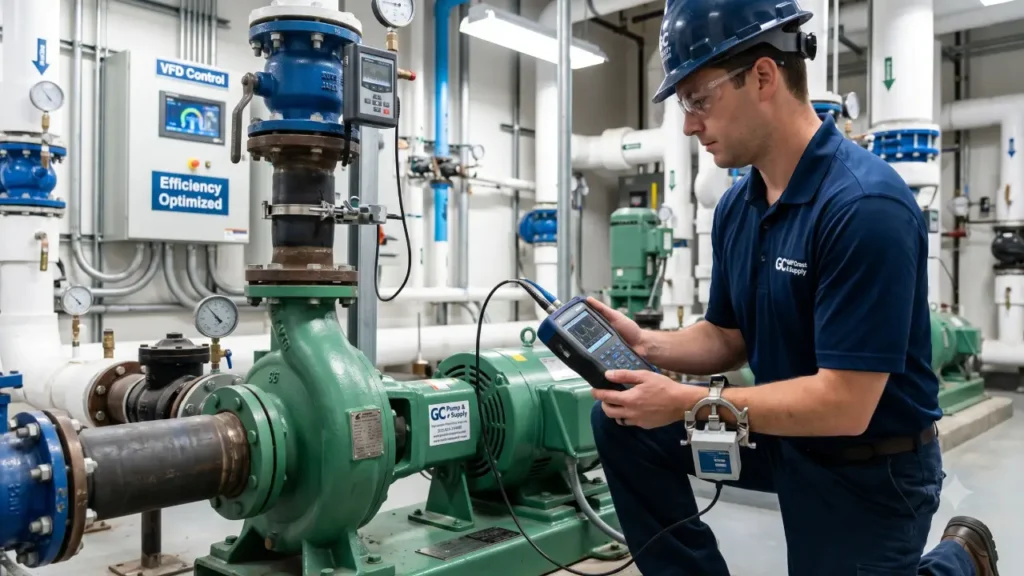
You cannot optimize what you do not measure. A professional pump audit in Houston or the Gulf Coast region is a non-invasive diagnostic process designed to build an exact energy profile of your mechanical room.
Durante un diagnóstico técnico en campo, los especialistas despliegan instrumentación especializada para evaluar la salud del sistema sin interrumpir tus operaciones:
-
Ultrasonic Flow Meters: Attached to the exterior of your piping to calculate exact flow rates (GPM) without breaking lines.
-
Digital Pressure Transducers: Installed at the suction and discharge nozzles to pinpoint the actual total dynamic head (TDH) being generated.
-
Power Quality Analyzers: Connected to the motor leads to log true power draw (kW), power factor, and motor efficiency.
Once this real-world data is collected, it is plotted directly against the manufacturer’s original performance curves. The resulting delta reveals precisely how much energy is being wasted and provides a clear ROI roadmap for corrections—whether that involves impeller trimming, VFD integration, or systematic pump replacement.
Schedule a Commercial Pump Efficiency Assessment
Don’t let inefficient engineering drain your operational budget month after month. Identifying misconfigured systems, shifting your operation closer to the Best Efficiency Point, and modernizing your control skids can yield immediate energy reductions of 20% to 40%.
At Gulf Coast Pump & Supply, we provide the industrial components, custom filtration, and engineering expertise required to keep Texas facilities running at peak performance.
Contact our technical team today to discuss your system specs or to schedule a comprehensive review of your facility’s commercial pumping infrastructure.